
Describe each packaging once — components, materials, weights, grade. PPWR Connect answers by jurisdiction: who the obligated producer is, what to declare, when, and produces the declaration from the same record. 30 SKUs from €29 a month.
Jurisdictions counted from our verified table — signalled, sourced or guided, each with its source; last verification 2026-09-26.
Article 39 & Annex VIII require mandatory Declarations of Conformity for all packaging from August 12, 2026. Collecting, validating, and maintaining DoCs across your supply chain is complex — manual processes create bottlenecks and audit risk.
EU recyclability criteria under Article 6 + Annex II — Grade A (fully recyclable), B and C. Packaging that fails to reach Grade C is banned from 1 January 2030 (or 24 months after the Article 6(4) delegated acts enter into force, whichever is later); only Grades A and B remain admissible from 1 January 2038. Every SKU must be assessed against the Article 6 methodology.
Recycled content targets for plastic packaging: PET contact-sensitive 30 %, other contact-sensitive 10 %, non-contact plastics 35 % — from 1 January 2030, or three years after the Article 7(8) implementing act enters into force, whichever is later. Requires mass-balance tracking and supplier verification now.
A regulatory team describes the same packaging five times: for the PPWR, for the German register, for PackUK, for a US producer responsibility organisation, for a Canadian one. Five files that diverge at the first weight change — and each scheme has its own obligated producer, thresholds, material categories and calendar. Nobody tells you which rule applies to which record.
From 12 August 2028 at the earliest, Article 12 requires a harmonised label on packaging placed on the EU market, conveying sorting and material info; a QR code or other data carrier is optional, mandatory only for reusable packaging and substances of concern. Where ESPR (Reg. 2024/1781) requires a Digital Product Passport for the product inside, the SAME data carrier must host both — so the packaging layer has to be DPP-ready when each ESPR delegated act lands.
Non-compliance results in products pulled from market, significant fines under Article 68, and reputational damage. Member state authorities conduct market surveillance with strict enforcement.
PPWR Connect centralizes all packaging compliance data, automates documentation workflows, and keeps you audit-ready across your entire portfolio. Built on the regulation text and the Commission's delegated and implementing acts as they are adopted under PPWR.
Send compliance requests to suppliers, track responses, validate against Article 39 requirements, generate audit-ready evidence trails — all from one dashboard. Upload a supplier's PDF and the platform reads it and files it as evidence.
Declare heavy metals, PFAS (Article 5(5) limit values), SVHC and bisphenol A per packaging component — present, absent or not declared, each with its source and supplier evidence. A blank never becomes a silent "no", and the declaration flows into the technical file, the DPP and the API.
Map your entire packaging portfolio. Track compliance status per SKU, per supplier, per market. Monitor deadlines: harmonised labelling from 12 August 2028 at the earliest, recycled-content and below-Grade-C ban from 1 January 2030, only Grades A and B from 1 January 2038.
Evaluate packaging against the EU recyclability criteria of Article 6 + Annex II (Grade A, B, C. Get grade predictions based on material composition and design. Receive redesign recommendations to clear the Grade C floor before 1 January 2030 at the earliest.
One record per packaging; the platform answers for each jurisdiction you name — who is the obligated producer, what to declare and when — with the official source and the date every rule was verified. Signalled, sourced or guided: the depth is shown, never assumed.
From 12 August 2028 at the earliest, every packaging on the EU market must ship with the Article 12 data carrier. Where ESPR (Reg. 2024/1781) requires a Digital Product Passport for the product inside, the same carrier must host both — generate the data structures, pictograms, material codes and sorting instructions you'll need.
Ask about your own portfolio from Claude, ChatGPT, Le Chat or Copilot — included on every plan. Connect your ERP over the REST API, let webhooks tell your systems when something changes, and open any item from the iPhone and Android apps.
One-click reports with version history, timestamps, and full evidence trails for authority inspections. Aligned with the regulation text and the Commission delegated and implementing acts as they are adopted.
Under PPWR Article 6 + Annex II, packaging is graded A, B or C by recyclable weight (≥ 95 %, ≥ 80 %, ≥ 70 %). Anything below Grade C is banned from the EU market on 1 January 2030 (or 24 months after the Article 6(4) delegated acts enter into force, whichever is later); only Grades A and B remain admissible from 1 January 2038.
Fully recyclable, mono-material
High recyclability, minor barriers
Moderate recyclability
Not recyclable — redesign required. Not a grade: the scale stops at C.
From 12 August 2026 the bulk of PPWR applies: substances of concern (Art. 5), manufacturer obligations (Art. 15), Declarations of Conformity (Art. 39), and producer registration / authorised representatives (Art. 44 & 45).
From 12 August 2026 the bulk of PPWR applies: substances of concern (Art. 5), manufacturer obligations (Art. 15), Declarations of Conformity (Art. 39), and producer registration / authorised representatives (Art. 44 & 45).
From 12 August 2028, or 24 months after the Article 12(6) implementing acts enter into force — whichever is later — packaging must carry harmonised material-composition and disposal pictograms. No annex carries those pictograms. Where another EU act mandates a digital product passport for the packaged product, the same data carrier must convey both sets of information; PPWR itself creates no such passport.
or 24 months after the Article 12(6) implementing act enters into force — whichever is later — Act not adopted (2026-09-02)
From 12 August 2028, or 24 months after the Article 12(6) implementing acts enter into force — whichever is later — packaging must carry harmonised material-composition and disposal pictograms. No annex carries those pictograms. Where another EU act mandates a digital product passport for the packaged product, the same data carrier must convey both sets of information; PPWR itself creates no such passport.
or 24 months after the Article 12(6) implementing act enters into force — whichever is later — Act not adopted (2026-09-02)
By 1 January 2029 every Member State must operate a Deposit Return System achieving at least 90% separate collection of single-use plastic and metal beverage containers up to 3 L (Art. 50). A Member State already above 80% over calendar year 2026 may request an exemption, due by 1 January 2028. Existing systems have until 2035 to align with Annex X.
By 1 January 2029 every Member State must operate a Deposit Return System achieving at least 90% separate collection of single-use plastic and metal beverage containers up to 3 L (Art. 50). A Member State already above 80% over calendar year 2026 may request an exemption, due by 1 January 2028. Existing systems have until 2035 to align with Annex X.
From 1 January 2030 (or 24 months after the Article 6(4) delegated acts enter into force, whichever is later) the A / B / C recyclability performance grades become binding for the packaging categories listed in Annex II, and packaging below the grade C floor may no longer be placed on the EU market. Article 6 defines only grades A, B and C. Annex II Table 3 sets the thresholds: grade A from 95%, grade B from 80%, grade C from 70%, and below 70% the unit counts as technically non-recyclable. What is still missing is the Article 6(4) delegated act fixing the design-for-recycling criteria and the weighting behind that percentage.
or 24 months after the Article 6(4) delegated act enters into force — whichever is later — Act not adopted (2026-09-02)
From 1 January 2030 (or 24 months after the Article 6(4) delegated acts enter into force, whichever is later) the A / B / C recyclability performance grades become binding for the packaging categories listed in Annex II, and packaging below the grade C floor may no longer be placed on the EU market. Article 6 defines only grades A, B and C. Annex II Table 3 sets the thresholds: grade A from 95%, grade B from 80%, grade C from 70%, and below 70% the unit counts as technically non-recyclable. What is still missing is the Article 6(4) delegated act fixing the design-for-recycling criteria and the weighting behind that percentage.
or 24 months after the Article 6(4) delegated act enters into force — whichever is later — Act not adopted (2026-09-02)
From 1 January 2035 packaging must also be recycled at scale — at least 55% at EU level for its Annex II category, 30% for wood — or five years after the relevant implementing acts enter into force, whichever is later.
or 60 months after the Article 6(5) implementing act enters into force — whichever is later — Act not adopted (2026-09-02)
From 1 January 2035 packaging must also be recycled at scale — at least 55% at EU level for its Annex II category, 30% for wood — or five years after the relevant implementing acts enter into force, whichever is later.
or 60 months after the Article 6(5) implementing act enters into force — whichever is later — Act not adopted (2026-09-02)
From 1 January 2038, packaging must be at least grade B to be placed on the EU market — grade C no longer suffices. This is enacting text, not guidance: Article 6(3) states it, and the 2038 column of Annex II Table 3 marks grade C as no longer placeable on the market.
From 1 January 2038, packaging must be at least grade B to be placed on the EU market — grade C no longer suffices. This is enacting text, not guidance: Article 6(3) states it, and the 2038 column of Annex II Table 3 marks grade C as no longer placeable on the market.
Article 7(2) sets a second wave of recycled-content requirements for 2040. The figures are not confirmed on a primary source — the only published indication is “up to 65% for single-use plastic bottles”, a ceiling rather than a floor. Do not plan against a number.
or 36 months after the Article 7(8) implementing act enters into force — whichever is later — Act not adopted (2026-09-02)
Article 7(2) sets a second wave of recycled-content requirements for 2040. The figures are not confirmed on a primary source — the only published indication is “up to 65% for single-use plastic bottles”, a ceiling rather than a floor. Do not plan against a number.
or 36 months after the Article 7(8) implementing act enters into force — whichever is later — Act not adopted (2026-09-02)
Everything about Regulation (EU) 2025/40: Declaration of Conformity, recyclability grades A, B and C under Article 6, recycled content targets, EPR, harmonised labelling, and all critical deadlines from August 12, 2026 through 2040.
Step-by-step checklist for importers and distributors to meet Declaration of Conformity (Article 39), importer liability, EPR obligations, and PPWR deadline of August 12, 2026.
Complete guide to PPWR documentation requirements: Declaration of Conformity (Article 39), the harmonised label and its data carrier, technical documentation, responsibility matrix for manufacturers/importers/distributors, and how enforcement and penalties work.
Mobile app
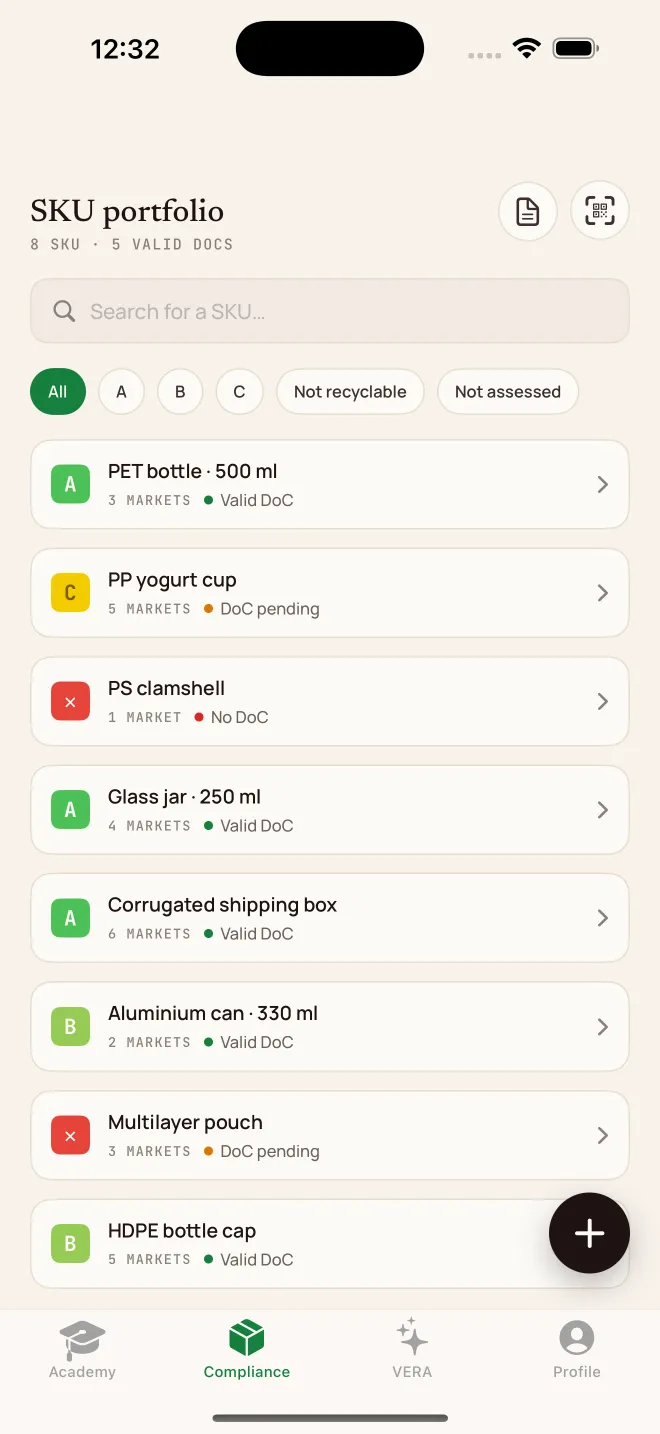
PPWR Connect is on the App Store and Google Play. Your portfolio, its recyclability grades and its documents, the Academy and VERA, on your phone, free to download.
iPhone and iPad (iOS 17 or later) · iPhone Duo ready · Android 8.0 or later · free download
PPWR Connect is built by VEORIA packaging compliance experts and regulatory specialists who understand Regulation (EU) 2025/40 from the inside — from Declaration of Conformity to Digital Product Passport implementation.
Our mission is to make Regulation (EU) 2025/40 compliance accessible, automated, and affordable — so you can focus on your products while we handle the regulatory complexity.
We're a team of packaging engineers, regulatory affairs specialists, software developers, and EPR compliance experts based across Europe. We've spent decades in packaging, label printing, sustainability, and regulatory compliance. We built PPWR Connect because we needed it.
PPWR Connect is a product of ColorLoop.ai — the multi-regulation compliance platform for packaging professionals — Regulation (EU) 2025/40 first, producer-responsibility schemes by jurisdiction.
Join 45+ companies preparing for Regulation (EU) 2025/40 with PPWR Connect — Declaration of Conformity, recyclability grades and EPR obligations in one workspace. Plans from €29 a month.